


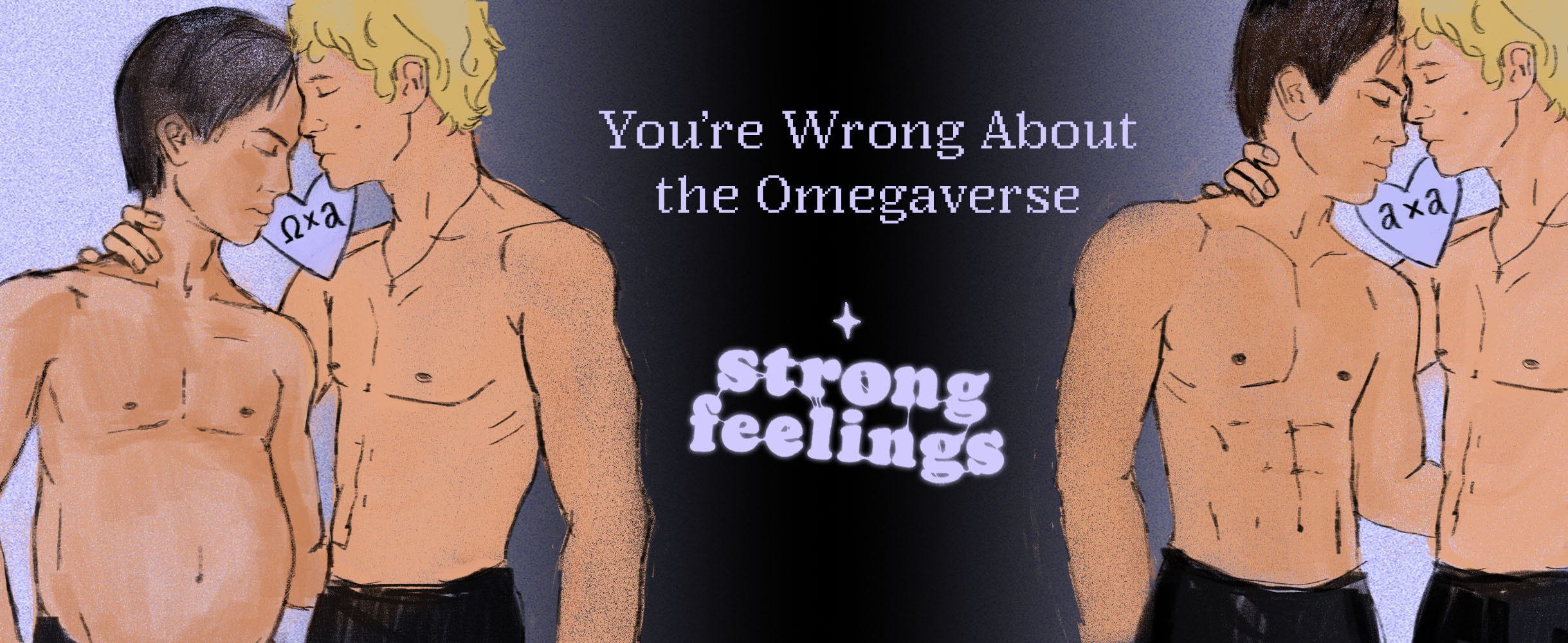
welcome to strong feelings! Essays by writers we love, in which they share their most impassioned opinions on a given subject. In today’s strong feelings, writer AJ Mason unpacks the Omegaverse,
Do y’all think Shane Hollander is an Omega, or Ilya? While fanfiction of the Heated Rivalry (HR) book series already existed, the TV show’s success has added an exorbitant amount of new fiction to its repertoire. And with this boom has come the Omegaverse adaptations, where authors are already dedicating pages to what it would be like to be an Omega in the hypermasculine world of professional hockey. Take ‘Heated Secret’ — a 12,000 word fic with almost 9,000 reads — for example, where Alphas are primed to play sports like hockey and Omegas are unheard of on the ice. Shane’s only hope for becoming a star player as an Omega is hiding his secondary gender from the very start…and falling for Ilya (an Alpha) can only complicate things for him. While the Omegaverse is complex — and I promise to explain every bit — there’s much more socio-cultural nuance and inherent inclusivity to it than meets the eye.
For those of you who haven’t been lulled to sleep with a nightly fanfic bedtime story for the past 15 years, I’ll give you some context to the Omegaverse. The Omegaverse – also known as A/B/O (alpha/beta/omega) – is a genre of erotic fiction that plays with ideas of systemic domination and oppression by employing the pack organizational structure of wolves and applying it to humans. Each person is assigned a “primary gender,” one that mirrors the gender structure we’re familiar with in our own world. But they are also assigned a “secondary gender”: Alpha, Beta, or Omega.
Alphas are the privileged class, blessed with power, physical prowess, and often seen as societally – and sometimes sexually – dominant. Betas sit in a neutral second position, while Omegas are typically the most oppressed class, often lacking the same civil rights as Alphas or Betas. Generally speaking, all Alphas can impregnate and all Omegas can be impregnated regardless of their primary gender — this is where the genres of “mpreg” or “male pregnancy” come into play, (which, by the way, have almost 120,000 tagged works on Archive of Our Own [colloquially called AO3]). Famously, Omegas also go through “heat” and Alphas go into “rut” which are biological cycles for each group that make their desire to mate and procreate with the other almost irresistible.
For years, the Omegaverse was an “if you know, you know” phenomenon, but recently, references to A/B/O dynamics have hit the mainstream: There are almost 250,000 works tagged with Alpha/Beta/Omega dynamics on AO3 and thousands of Omegaverse videos on TikTok. The Heated Rivalry actors Connor Storrie and Hudson Williams even discussed the Omegaverse during their viral press tour last month.
While some are adamant about Shane’s Omega status, others — like internet personality Anania — claim the opposite. Personally, I think both suggestions are wrong. The boys, in my opinion, are obviously in an Alpha/Alpha relationship, with Shane coming to terms with being a submissive Alpha. Shane’s feelings of shame surrounding his gay identity in a hypermasculine sport parallels the fics that explore Alpha/Alpha dynamics, as one Alpha will always have to occupy the role of “recipient”. Regardless of one’s conclusion though, the prevalence of this conversation perfectly illustrates an irrefutable fact: the power and strength of the Omegaverse in the fanfiction community is undeniable. If fanfiction had a golden child, a champion, a winner, it would undoubtedly be the Omegaverse. If a piece of media garners an intense fan response, Omega and Alpha speculations (and stories) are sure to follow.

The thing is, the Omegaverse has grown exponentially in the past 15 years since its purported inception, and it’s done so because of the worldbuilding endemic to the universe. While many are skeptical of the genre due to the prevalence of dubious consent (more on this later), it’s ultimately so compelling because it allows both authors and readers to explore the gendered power dynamics and social structures that exist in our own world, but in new bodies and in new forms. Many works also unpack notions of gender, sexuality, and consent under oppression, illustrate and critique systemic inequality, and imagine worlds with fundamentally new understandings of queerness.
In every iteration of Omegaverse fiction, the world is just like our own: a caste system, justified by the so-called “innate” biological aspects of certain bodies and the roles we are told they must embody. While the concept of secondary gender erases the concept of primary gender oppression in this universe, it introduces an entirely new form of bioessentialism, say researchers Xiaoyan Yang and Frederico Pianzola in their paper on the gender power difference in the Omegaverse*. This structure gives authors room to discuss gender-based oppression in unique ways, often pulling apart and isolating distinct aspects of how this oppression manifests and doing so in such an exaggerated way such that it’s impossible to ignore.
The biological imperative to mate opens up questions around consent and the subordination of Omega bodies, which is a core aspect of the genre. (Take for example Destined For Heat, a workplace Omegaverse manga where Omegas are in constant fear of Alphas going into terrifying ruts around them when they are in heat.) Similarly, the “mpreg” feature fundamentally reimagines cis bodies and ascribes a traditionally gendered oppression onto those we don’t typically associate it with by allowing all Omegas to give birth. This, then, often highlights the connection between birth-giving and societal subordination. What roles are forced upon the body that bears the child, what are the societal expectations, and how do these characters navigate them? In our current political climate filled with attacks on reproductive justice, what better time to read a fanfic about Omega Shane Hollander’s decision to get an abortion due to his deep love for hockey?

There are countless Omegaverse stories where the characters themselves are critical of the world around them. These stories are erotic, yes, but they’re also romantic, and hone in on the specific ways characters navigate oppression interpersonally. For many marginalized people, it’s impossible to remove our relationships from the structural context in which we exist. At its core, the Omegaverse explores the habits we form and survival tactics we employ when negotiating consent and love from unequal playing fields. How do we create meaningful relationships in a society with a perpetual imbalance of power? From stories that reference Omega equality movements and the invention of suppressants that help Omegas navigate their ‘heats’ more safely, to new laws passed that criminalize Omega assaults or kidnappings, or allow Omegas to work or own property, I’d argue that many of these stories actually explore the legacies left by activists and the impact that ongoing power struggle has on our main characters’ day-to-day lives.
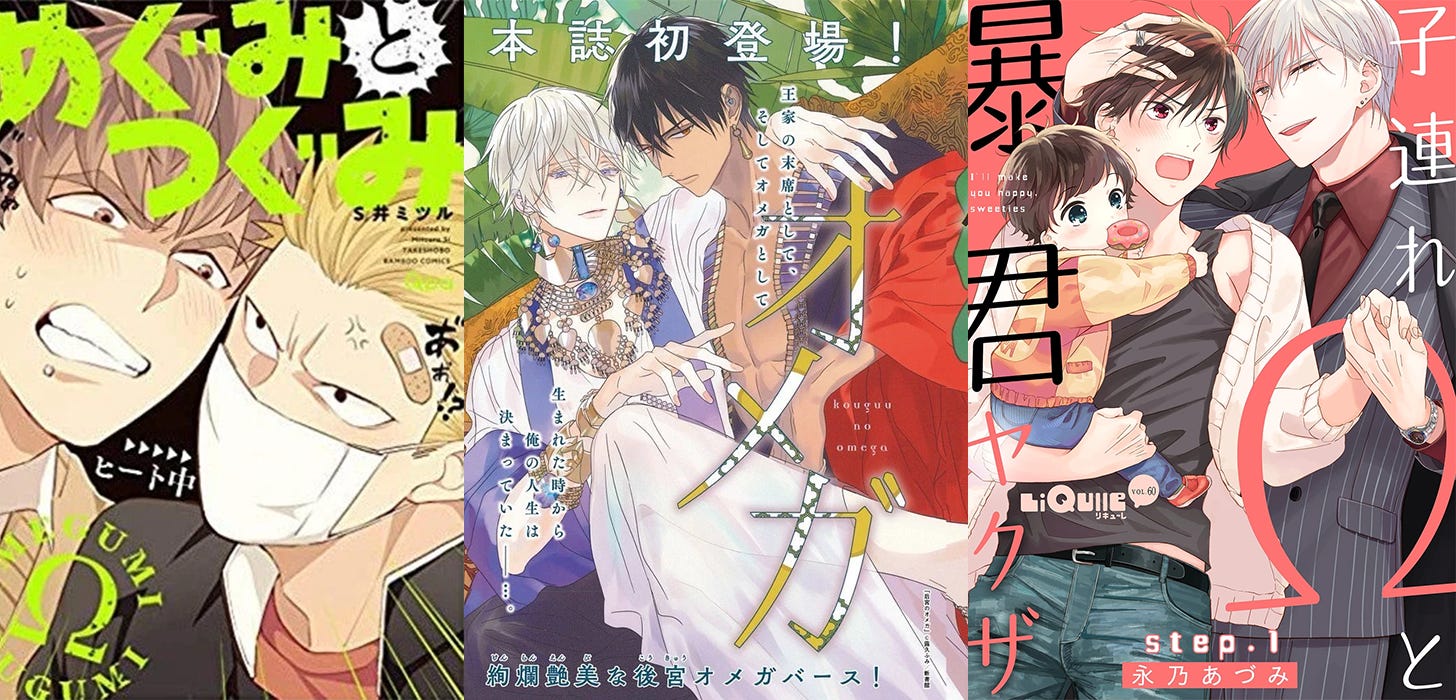
Brit, known as The Buff Fujoshi on TikTok, is a content creator whose page is dedicated to Boys Love (BL) manga. BL manga embraced the Omegaverse as early as 2015 with numerous stories set in the universe, like Megumi & Tsugumi, Kouguu no Omega, and Kozure Omega to Boukun Yakuza. Brit explained that they were initially hesitant to read Omegaverse manga because of the oppressive world and its exploration of violent topics, but that in getting to know the genre they found a commonality between themself as a Black person and Omega characters trying to navigate a world built against them. On the flip side, Brit had a surprising realization when first getting into Omegaverse fiction: Though they strongly resonate with characters trying to fight against stereotypes, they expressed that the Omegaverse has also given them more empathy for characters who choose to keep their heads down — who grin and bear it in hopes of surviving.
Another common framework we see in the Omegaverse is that many characters try to build a relationship that successfully combats the dominant system imposed on them by society and their biology. Many of us attempt dating despite systemic power imbalances in real life, too, whether that be across gender lines or across other axes of power like race or disability. Seeing characters attempt to negotiate similar issues in their relationships and still create loving connections can be particularly powerful. Brit discusses reading the BL manga No God in Eden, which follows Takai and Nishio as they navigate the realization that they are the world’s first Alpha and Omega, as Nishio is enraptured by a surprise heat and consequently, the need to reproduce. The story illustrates the struggle the characters face when trying to form a real romantic connection despite the power dynamics that are thrust upon them.
There is inherently queer storytelling in the Omegaverse, too, from stories that feature Omegas who would do anything in their power to hide the fact that they are Omega – a concept that is sometimes given a trans reading — t0 fics that center stories that divest from dating Alphas entirely (shoutout to all the feminist Omegas #decentering-alpha-romance). There are also many stories that feature two Omegas or two Alphas dating. The latter relationships, in particular, often have a similar trajectory to queer relationships in our current world, being seen canonically as “taboo” in the Omegaverse. Since same-sex relationships of one’s primary gender are generally normalized in the Omegaverse, and queer sex is a codified cultural norm, it allows us to play with an entirely new and reimagined form of queerness focused on secondary gender. For example, two Omegas together are often seen as “wasting their wombs” and their divestment from centering Alphas as a societal affront, which is a sentiment I’m all too familiar with as a queer woman in the real world. Yet, these stories show the often characters persevering, shunting societal expectations and finding genuine romance.
Nonetheless, it’s also impossible to discuss the Omegaverse without noting the rampant oppression and culture of non-consent. The more intense stories within the genre may include aspects like enslaved, kidnapped, or brutalized Omegas, and the biological essentialism used to justify this violence should be rightfully questioned – these fictions are certainly capable of making light of problematic dynamics. However, depiction and validation are not synonymous either; to explore does not require one to condone. Facing the intersections between our fantasies, fears, lived experiences, and sexual desires is often complex, and this medium is perfectly positioned to help us explore those nuances – even if those circumstances are imperfect or uncomfortable.
Ultimately, erotica of any kind is not new to facing derision because genres that center desire often show us at our most debased; the dirt under our nails we’d much prefer to hide. Regardless, the Omegaverse has solidified its place in the digital zeitgeist. When it comes to media that depicts the complexity of desire, it can be much more interesting and impactful to explore it from a less judgemental and “morally pure” standpoint and instead to approach it with a desire to understand human nature. The persistence of the genre is proof of how compelling it is and the power that it has to help us understand one another more deeply while challenging the world around us, if we choose to do so.
*Yang, Xiaoyan and Pianzola, Federico (2024). Exploring the Evolution of Gender Power Difference through the Omegaverse Trope on AO3 Fanfiction, Centre for Language and Cognition, University of Groningen, The Netherlands.
Absolutely! The Omegaverse can seem confusing at first, but at its core it’s a fictional world with dynamics like alphas, betas, and omegas kind of a way to explore relationships and social hierarchies in stories.
This is everything I am exploring. Honestly omegaverse is my favorite trope and I am not embarrassed to say so!